



What Is Ladino (Judeo-Spanish)? Its History and the Alphabets Used
Ladino—also known as Judeo-Spanish—is a language from a "lost" culture that has defied the centuries. With roots tracing back to 15th-century Spain, it is a fascinating heritage that has evolved as it traversed different geographies, yet has never truly vanished. So, how exactly did the Ladino language emerge? Which alphabets were used to write it throughout history, and why has it shifted to the Latin alphabet today?
In this article, we take a closer look at the origins of Ladino—the legacy of the Sephardic Jews—and the evolution of the scripts used to write it.
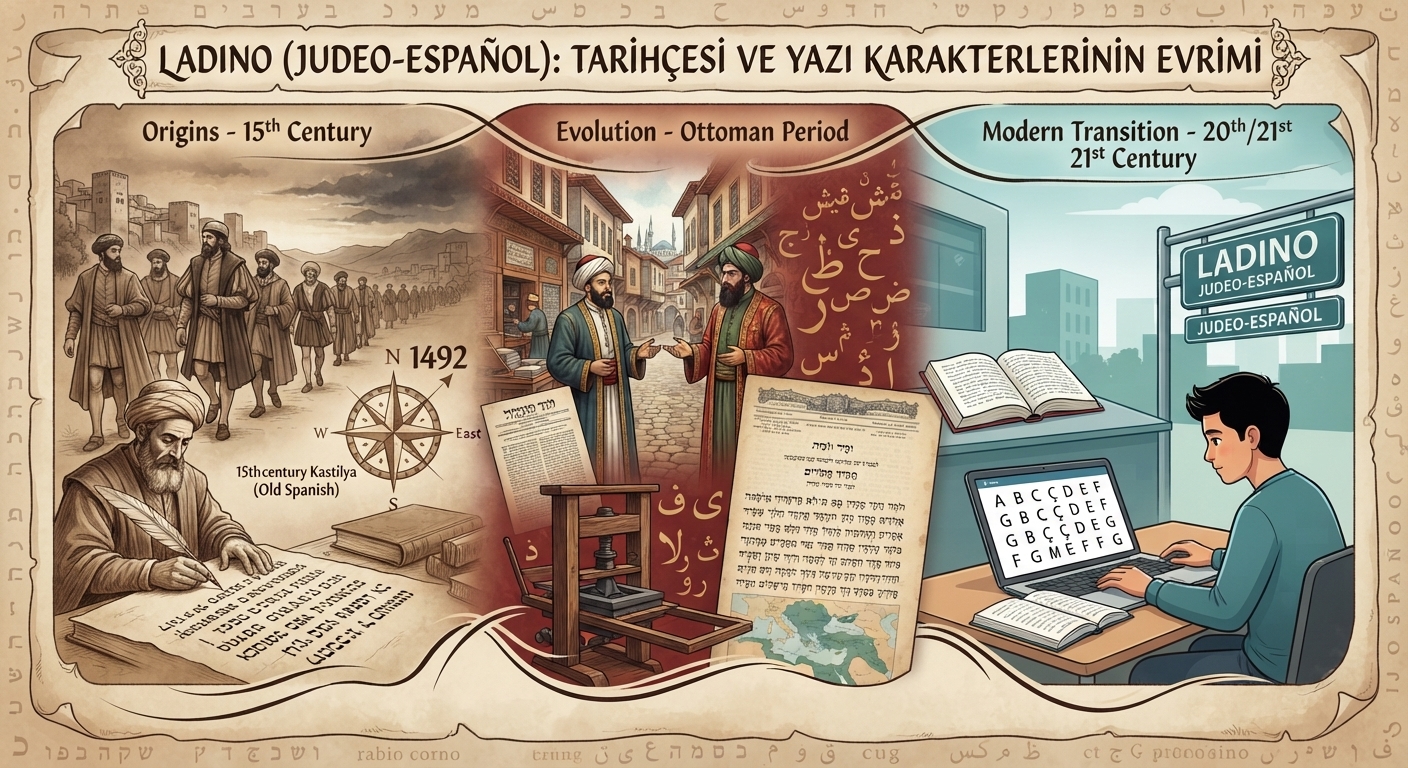
1. The Origin and History of the Ladino Language
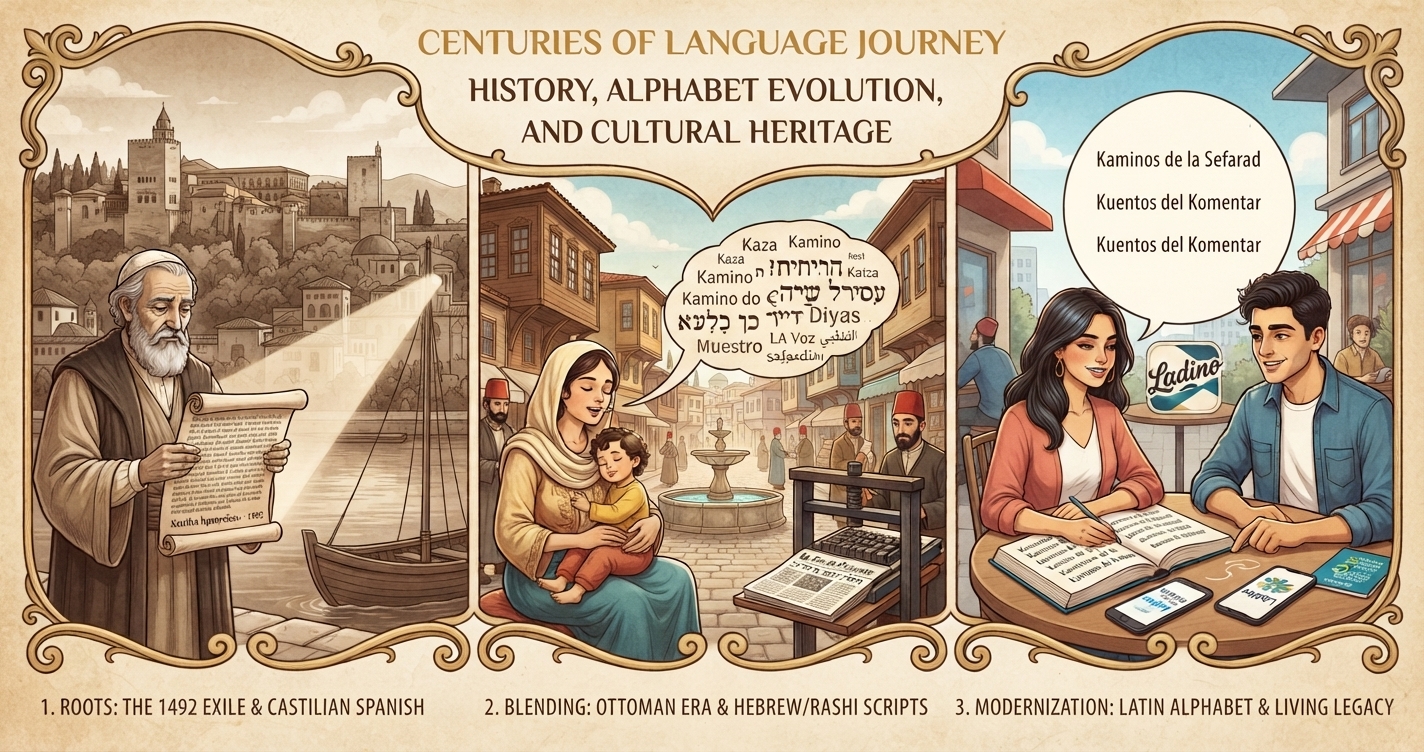
Ladino is, in essence, a derivative of 15th-century medieval Spanish (Castilian Spanish). Following the Alhambra Decree—signed in 1492 by King Ferdinand and Queen Isabella of Spain—the Jews of Spain (the Sephardim) were expelled from their homeland.
As the Sephardim migrated to various regions—most notably the Ottoman Empire, but also North Africa, the Netherlands, and Italy—they carried 15th-century Spanish with them. In these new lands, the language became blended with Ottoman Turkish, Hebrew, Arabic, Greek, and various Balkan languages; over time, it developed a distinct identity and came to be known as Ladino.
While Ladino was preserved for centuries primarily as an oral tradition and a domestic, household language, it eventually evolved into a written culture, appearing in newspapers, literature, religious practice, and personal correspondence.
2. Alphabets Used for Ladino Throughout History
Depending on the region and the era, Ladino has been written using various alphabets and scripts. The primary forms used throughout its history include:
The Hebrew Alphabet and the Rashi Script: Following the expulsion and throughout the Ottoman period, Ladino texts were predominantly written using the Hebrew alphabet, running from right to left. For religious texts, printed works, and newspapers, a specific typeface—part of the Hebrew family of scripts—known as "Rashi" was employed. Solitreo (Cursive Script): For everyday communication, personal correspondence, and private notes, the community used "Solitreo"—a more fluid, cursive form of the Hebrew script (somewhat analogous to the *Riq'a* style in the Arabic script). While the *Rashi* script was taught in schools, people typically used Solitreo for quick, informal writing at home.
The Modern Era and the Latin Alphabet: From the late 19th century onward—driven largely by the influence of French culture and the *Alliance* schools—the Latin alphabet began to be adopted. Today, in an effort to preserve this endangered language and make it more accessible to new generations, the Latin alphabet is used exclusively (employing a phonetic system closely aligned with Turkish and Spanish).
Conclusion: A Heritage on the Verge of Being Forgotten
Ladino—classified today by UNESCO as an "endangered language"—is more than just a collection of words; it represents a rich history filled with traditional folk verses, proverbs, recipes, and poignant Sephardic ballads passed down from ancestors. Regardless of the alphabet used to write it, Ladino continues to serve as a bridge between cultures.
Have you ever heard of the Ladino language before? Share your thoughts with us in the comments!
Did you enjoy this post?
Tell Michael with a like, and pass it on to someone who loves Ladino.



Comments 0
No comments yet. Be the first to share what this post means to you.
Sign in to write a comment and keep your favourites.